
Google has unveiled Gemini 4 Argon, its latest frontier AI model, positioning it as a workhorse for complex software engineering, enterprise knowledge work and cybersecurity defense.
The model is not launching as a broadly available chatbot. Google is initially giving access to a limited group of trusted cyber defenders through its Fairwind Program, while it works on additional safeguards and participates in the U.S. government’s voluntary pre-release model access process. Broader availability is planned for developers, enterprises and consumers.
That restricted rollout is one of the most notable parts of the announcement. Google says Argon is capable of handling long-running, complex workflows that can involve coding, vulnerability discovery, financial and legal analysis, and other enterprise tasks.
Google Is Betting on Long-Horizon AI Work
Gemini 4 Argon is designed around a shift in how Google sees advanced AI being used.
Instead of focusing primarily on conversational responses, the company is emphasizing multi-step workflows in which an AI model can reason through a problem, use tools and continue working for longer periods.
Google says Argon delivers frontier performance across software engineering, enterprise knowledge work and cybersecurity. The company also highlights applications in areas such as legal and financial research.
One of its most unusual specifications is its 1 million-token output capability, which Google says is industry-leading. A larger output ceiling can be particularly useful for long coding sessions, large-scale code migration, extensive research and other workflows where an AI system needs to maintain a large amount of generated work.
Coding and Cybersecurity Are Central to the Launch
Google is putting significant emphasis on software engineering.
The company says Argon is already being used internally by Google teams for coding and research. Google also reports that Argon agents have helped work on projects including Rust migration and optimization of its libgav1 video decoder.
Cybersecurity is an even more unusual part of the launch.
Google says Argon can autonomously identify, validate and patch critical software vulnerabilities. Rather than immediately releasing those capabilities to everyone, Google is giving the model to trusted cyber defenders first through Fairwind.
The approach reflects a growing concern around increasingly capable AI systems: the same capabilities that can help defenders find vulnerabilities can potentially be misused by attackers.
Google says it is strengthening safeguards against cyber misuse, indirect prompt injection, model misalignment and insecure agent environments before broader availability.
Google Claims a Broad Benchmark Lead
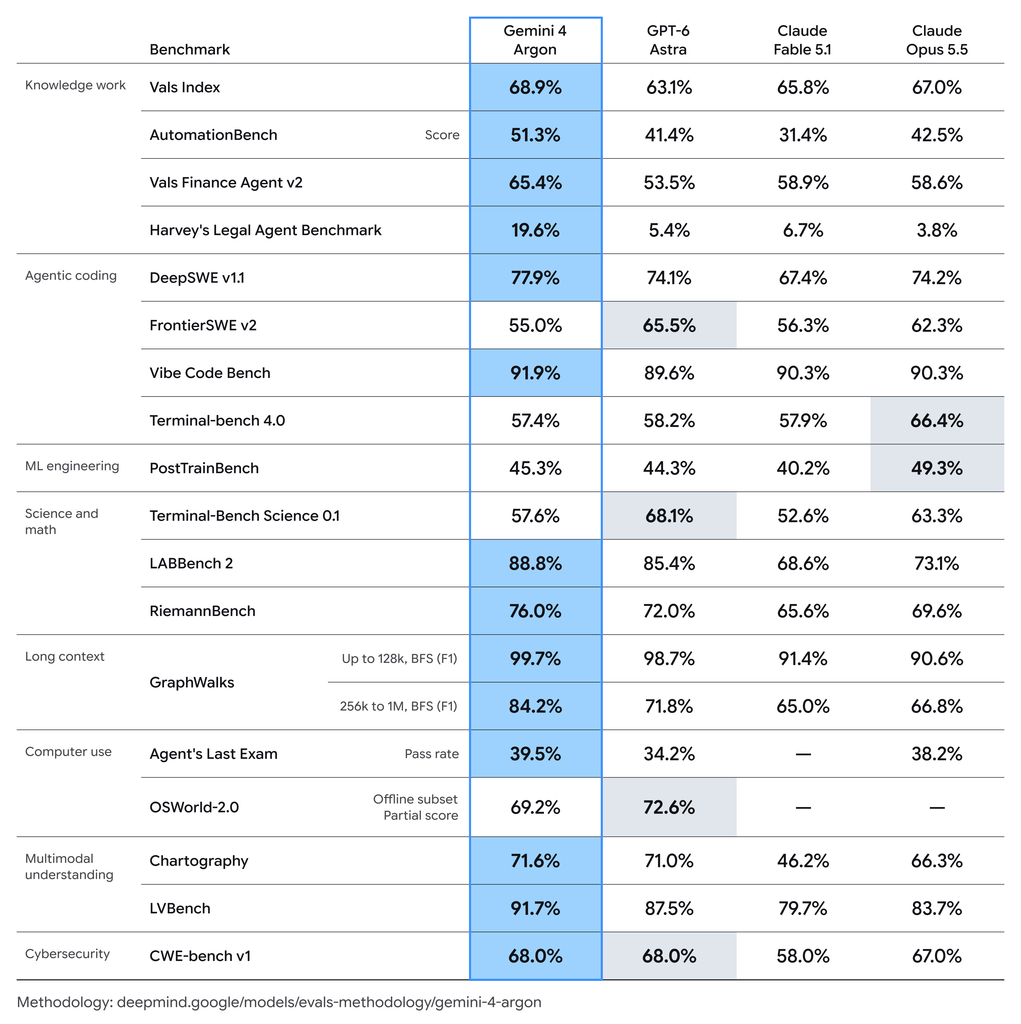
Google’s published benchmark comparisons show Argon leading or tying rival frontier models across many of the categories the company considers important for enterprise AI.
The model performs particularly strongly in areas including long-horizon software engineering, business automation, financial analysis, legal work and cybersecurity.
On the benchmarks disclosed by Google, Argon leads on most of the 18 evaluations in its comparison set, although rival models from OpenAI and Anthropic remain ahead on several individual tests.
That distinction matters. Google is not demonstrating that Argon wins every possible AI task. Instead, it is making a broader argument that the model has become highly competitive across a wide range of professional workloads.
For businesses evaluating AI systems, that breadth may be more important than a single benchmark score.
The Pricing Is Designed to Compete
Google is also using pricing as part of its strategy.
Gemini 4 Argon will initially cost $2 per million input tokens and $10 per million output tokens, with Google offering a significant discount for cached input. After the introductory period, Google says pricing will increase to $4 per million input tokens and $20 per million output tokens.
The pricing puts Google directly into competition with premium models from OpenAI and Anthropic, particularly for developers building AI agents and enterprise applications where token costs can quickly become significant.
But price alone may not determine adoption.
Companies will also evaluate reliability, latency, context handling, security, data policies, tool use and how well a model performs inside their existing software stack.
Google Is Changing How It Launches Frontier Models
The limited initial release is perhaps the clearest signal from the announcement.
Rather than immediately putting Argon in front of millions of consumers, Google is starting with cybersecurity defenders and other trusted users. The company says feedback from those users will help improve safeguards before wider distribution.
That approach reflects how the frontier AI market is changing.
As models become capable of writing software, operating tools, analyzing sensitive information and discovering security vulnerabilities, the question is no longer simply whether a model is intelligent enough.
The question is whether it can be deployed safely enough to perform useful work without creating new risks.
Gemini 4 Argon is Google’s latest attempt to answer both questions at once.
For Google, the launch is also strategically important. The company is competing against increasingly capable models from OpenAI and Anthropic, while trying to turn its enormous cloud, developer and enterprise distribution into an advantage.
Argon gives Google a new flagship model built around the workloads businesses are increasingly asking AI to handle.
The next test will be broader availability – and whether Argon’s benchmark performance translates into reliable results when developers and enterprises put the model to work on their own problems.
Sources: