

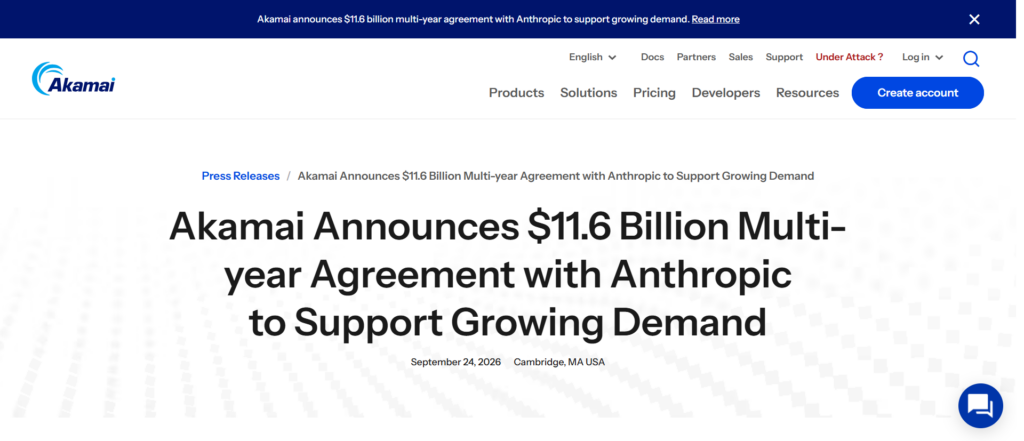
Anthropic has signed a seven-year, $11.6 billion agreement with Akamai Technologies for cloud computing services, adding another enormous infrastructure commitment to the rapidly expanding cost of building and operating advanced AI systems.
Announced September 24, the agreement will give Anthropic access to dedicated cloud computing capacity and managed support services from Akamai. The companies can expand the relationship by another $9 billion, potentially taking the total commitment to approximately $20 billion.
The deal also gives Anthropic a potential ownership stake in Akamai. Under the agreement, Akamai issued Anthropic a warrant that could represent up to approximately 5% of Akamai’s common stock if the relationship reaches its expansion milestones. About 2% is tied to the initial $11.6 billion commitment, while the remaining 3% would vest as additional spending is reached.
The arrangement highlights a growing reality of the AI industry: building increasingly capable AI systems requires not only powerful models, but enormous amounts of computing infrastructure.
Why Anthropic Needs More Cloud Capacity
Akamai said Anthropic will use its distributed cloud infrastructure and software primarily to support growing CPU workloads at scale.
That is notable because the AI infrastructure conversation is often dominated by GPUs. Training and running advanced AI models involves multiple types of computing, however, and CPU resources remain important for data processing, orchestration, application workloads and other parts of an AI system.
Anthropic has been rapidly expanding its infrastructure commitments as demand for its AI products grows.
Reuters reported that the company has also agreed to spend $45 billion to rent AI cloud computing capacity from Nscale’s West Virginia data center campus.
The Akamai agreement therefore represents another major piece of Anthropic’s broader infrastructure strategy rather than a standalone cloud purchase.
Akamai Will Have to Spend Billions to Support the Deal
The size of the contract does not mean Akamai receives $11.6 billion immediately.
Akamai estimates that it will require approximately $5.5 billion in total capital expenditures related to the initial commitment. The company expects to increase its 2026 capital expenditures by approximately $1.7 billion, including spending to secure and pre-purchase components such as memory.
Akamai said the agreement is not expected to change its 2026 revenue guidance.
The company also said the Anthropic commitment adds to more than $2.8 billion in multi-year cloud infrastructure commitments it has announced across its customer base during 2026.
That suggests Akamai is positioning its distributed cloud infrastructure as an alternative capacity source for organizations that need to run increasingly demanding AI workloads.
The Deal Includes an Unusual Equity Component
The agreement is also notable because of the warrant attached to it.
Anthropic received a warrant for convertible preferred stock that represents up to approximately 5% of Akamai’s common stock on an as-converted basis.
Around 2% is expected to vest based on the initial $11.6 billion commitment. The remaining 3% is connected to the potential $9 billion expansion, with approximately 1% tied to each additional $3 billion of cloud services purchased under mutually agreed terms.
Reuters reported that the warrant gives Anthropic the right to purchase Series B shares at $111.33 each.
For Akamai, the structure ties part of Anthropic’s potential ownership directly to the growth of the commercial relationship.
For Anthropic, it provides a potential financial interest in an infrastructure provider that it expects to use at substantial scale.
AI Infrastructure Is Becoming a Long-Term Commitment
The agreement illustrates how AI companies are approaching computing capacity differently from conventional software businesses.
Traditional software companies can often expand infrastructure incrementally as customers arrive. Frontier AI companies, by contrast, may need to secure large amounts of computing capacity ahead of demand because training and serving increasingly capable models can require enormous infrastructure investments.
Anthropic’s agreement with Akamai runs for seven years.
That makes it a long-term infrastructure commitment rather than a short-term capacity purchase.
The company’s decision to secure capacity across multiple providers also reflects the increasingly complex infrastructure requirements surrounding AI models and applications.
For businesses following the AI market, this creates an important distinction between the AI model layer and the infrastructure required to make those models useful at scale.
QueryFeedz readers can explore related concepts through its AI model and AI system explainers.
What the Deal Says About AI’s Infrastructure Economy
The Akamai agreement is another indication that AI growth is creating demand far beyond model developers.
Cloud providers, data center operators, networking companies, semiconductor suppliers and memory manufacturers are all becoming part of the infrastructure chain required to support AI workloads.
Akamai’s own September research also highlighted the growing security and infrastructure challenges created by agentic AI. The company said enterprises are increasingly dealing with autonomous software entities that operate across APIs and systems.
That means infrastructure providers increasingly need to support not just AI model training, but the applications and agents that use those models.
What Happens Next?
Akamai’s agreement provides Anthropic with a substantial long-term source of computing capacity, while giving Akamai a major customer commitment tied to the continued expansion of AI workloads.
The potential $20 billion total relationship is not guaranteed. The additional $9 billion depends on future expansion of the agreement.
What is already clear is the scale of infrastructure being committed to AI.
As AI companies develop more capable models and deploy increasingly complex applications and agents, the economics of computing capacity will become an increasingly important part of the technology industry.
The Anthropic-Akamai agreement puts a $11.6 billion number on one part of that infrastructure race – with another $9 billion potentially still ahead.