
OpenAI is testing a new advertising format that could change how brands interact with potential customers inside ChatGPT.
Called Sponsored Agents, the feature allows a user who clicks a ChatGPT ad to start a separate conversation with an AI agent sponsored by the advertiser. Instead of immediately sending shoppers to a company’s website, the ad can now become a conversational step where customers ask questions, explore products or services, and eventually follow a link to the business.
The test began September 16 with selected advertisers in the United States.
OpenAI says the sponsored conversation is separate from both the user’s original ChatGPT conversation and ChatGPT’s independent answers. That distinction is important because the company is positioning Sponsored Agents as an advertising experience rather than allowing advertisers to influence ChatGPT’s responses.
How ChatGPT Sponsored Agents Work
The basic experience is relatively straightforward.
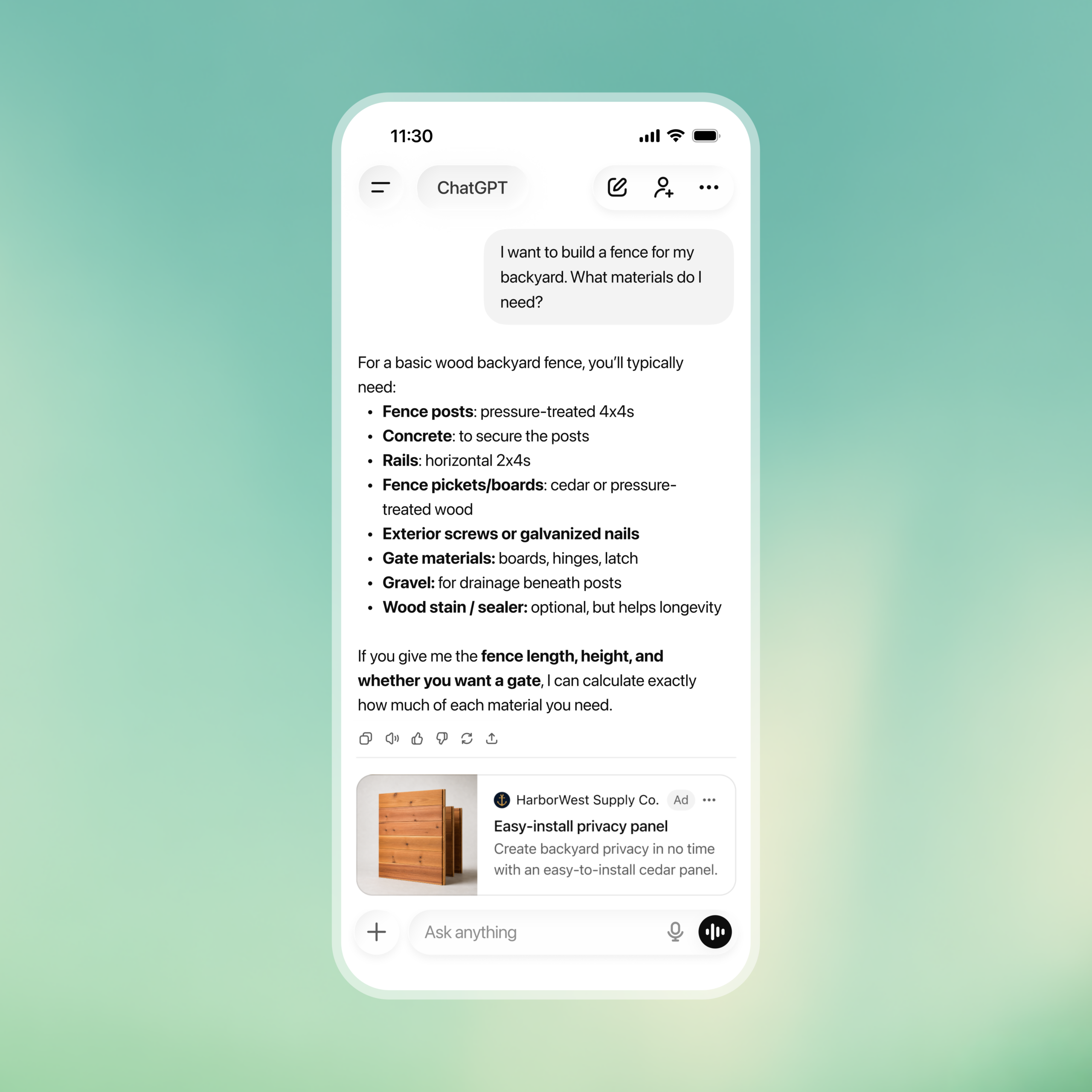
A user encounters a relevant sponsored advertisement underneath a ChatGPT response. After clicking the ad, the user can choose to begin a clearly labeled conversation with the advertiser’s AI agent.
The user might ask questions about a product, compare options or explain what they are looking for. The sponsored agent can then provide information about the company’s offerings and eventually direct the customer to the advertiser’s website.
OpenAI uses a furniture-shopping scenario to illustrate the concept. Someone considering a dining table might want to know whether it will fit in a particular room, how many people it can accommodate or how to care for its surface.
That makes the format different from a conventional display or search ad. The advertiser is no longer simply paying for a message or a click; the advertising experience can include an interactive conversation.
Brands Get a New Place in the Buying Journey
The early examples show why the format could be particularly relevant to businesses selling products or services that require consideration before purchase.
OpenAI has identified Wayfair as an early Sponsored Agents participant, while home-services marketplace Angi has also announced a related experience. Other reporting has identified brands including Newegg, Best Buy, Lowe’s and VistaPrint as participants in the early testing.
For a company such as a furniture retailer, the conversation might involve product specifications or suitability.
For a home-services marketplace, the interaction can be more task-oriented. A customer could describe a home project and move toward the company’s service-request process.
The broader idea is that advertising inside an AI assistant can become part of the consideration process instead of simply interrupting it.
OpenAI Is Keeping Sponsored Agents Separate From ChatGPT’s Answers
One of the most important distinctions in the rollout is the separation between OpenAI’s assistant and the advertiser-sponsored agent.
OpenAI says Sponsored Agent conversations are distinct from ChatGPT’s independent answers and separate from the original conversation initiated by the user. Advertisers therefore are not being given a mechanism to modify or rank ChatGPT’s answers.
OpenAI’s broader advertising documentation also says advertisers do not receive users’ ChatGPT conversations, chat history, memories or personal details. During the early advertising test, advertisers receive aggregated performance information such as views and clicks. If a user directly messages an advertiser through an ad, the advertiser can see the messages that user sends to it.
For users, that creates an important distinction: ChatGPT’s answer and a brand’s sponsored conversation are two different experiences.
The Advertising Business Is Expanding Beyond the Ad Unit
Sponsored Agents are only part of OpenAI’s latest advertising push.
The company is also adding AI-powered tools for advertisers. Businesses can use natural-language prompts through the Ads Manager experience to create, update and analyze campaigns.
OpenAI is also introducing AI assistance for advertising creative, including suggested copy and imagery based on a landing page and campaign objective. Advertisers can review and edit those suggestions before using them.
The company is additionally testing optional AI-powered text customization, which can adapt advertising copy to conversational context and translate it into a user’s preferred language.
OpenAI has also named HubSpot as its first CRM partner and Shopify as its first ecommerce partner for ChatGPT Ads.
That points toward a broader strategy: OpenAI is not simply adding advertisements to ChatGPT. It is building an advertising infrastructure around an AI-driven customer journey.
What This Means for Marketers
For marketers, Sponsored Agents introduce a different model for conversational advertising.
Traditional digital advertising generally separates the stages of discovery, consideration and conversion. A person sees an advertisement, visits a website, reads product information and eventually contacts a company or completes a purchase.
A conversational AI system can potentially compress several of those steps.
A customer can describe a need, ask follow-up questions and receive product or service information before leaving ChatGPT.
That could be especially relevant for businesses where customers need guidance before making a decision.
However, Sponsored Agents are still an early experiment. OpenAI says access is currently limited to selected advertisers in the United States, and there is no indication yet that the format is broadly available to every advertiser.
ChatGPT Ads Are Still Limited to Certain Plans
The Sponsored Agents test sits within OpenAI’s broader ChatGPT advertising program.
According to OpenAI’s current advertising documentation, ads may appear for users on the Free and Go plans. Plus, Pro, Business, Enterprise and Edu accounts do not have ads. OpenAI also says accounts identified as belonging to users under 18 are excluded from ads.
OpenAI began testing ads in the United States in February 2026 and has been expanding the program gradually.
The company says advertisements do not influence ChatGPT’s answers and that advertisers cannot shape, rank or alter those responses.
What Happens Next
The key question is whether users find sponsored conversations useful enough to engage with them.
For advertisers, another question will be whether conversational engagement translates into measurable business results.
OpenAI already provides advertisers with metrics such as impressions, clicks, spending, click-through rate and conversions through Ads Manager. The company also supports conversion measurement and tracking parameters for ChatGPT advertising campaigns.
Sponsored Agents add another layer to that process: the interaction itself becomes part of the customer journey.
For now, OpenAI is treating the format as a limited test. If the experiment expands, it could become an important new category of conversational advertising, where the ad is not merely something a customer sees but a gateway into an AI-powered brand interaction.
Sources
- OpenAI — Reimagining advertising with AI — Primary announcement for Sponsored Agents and the latest advertising tools.
- OpenAI Help Center — Sponsored Agents in ChatGPT Ads — Current availability and early-access information.
- OpenAI Help Center — Ads in ChatGPT — Advertising eligibility, privacy, personalization and user controls.
- Reuters — OpenAI tests advertiser-sponsored agents — Independent reporting on the September 2026 announcement.
- Ad Age — The source article supplied for this story, covering OpenAI’s Sponsored Agents and advertiser controls.