

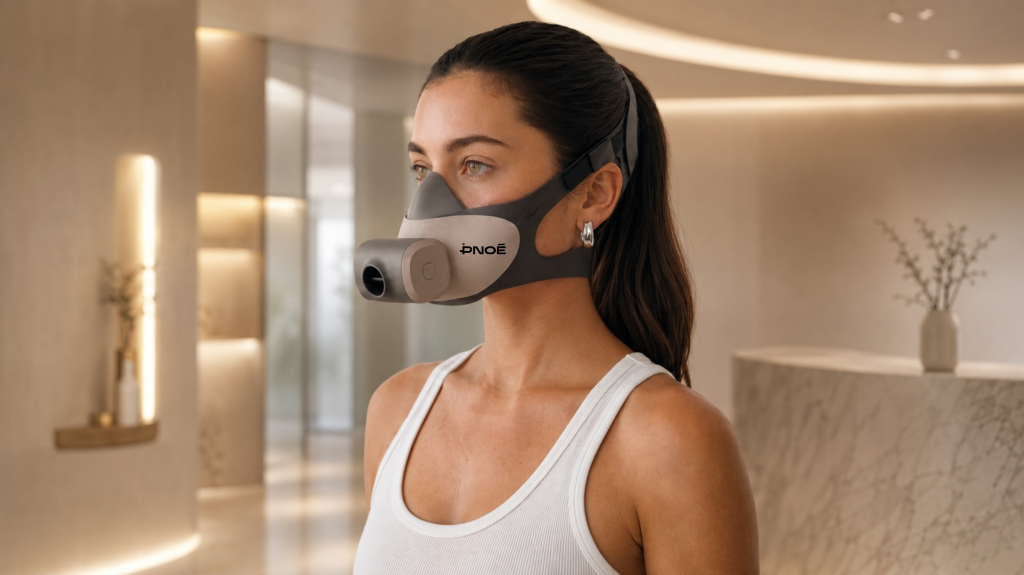

PNOĒ plans to launch a smaller breath-analysis device on October 1 that lets users conduct an eight-minute metabolic test without a trained operator. The company is betting that simpler hardware can expand access to measurements such as VO₂ max and resting metabolic rate.
PNOĒ is preparing to put a new version of its breath-analysis system into gyms and other wellness settings, removing one of the biggest barriers to using its existing technology: the need for a trained person to administer the test.
The Massachusetts-based company says its PNOĒ 2.0 will allow users to put on a mask, start the device and complete an eight-minute breathing session on their own. The company plans to launch the system on October 1, according to TechCrunch.
The change could expand where metabolic testing can be offered. PNOĒ’s existing system requires an operator, while the new version is designed for businesses that may not have specialized staff available to conduct every test. CEO and co-founder Apostolos Atsalakis told TechCrunch that gyms and potentially pharmacies could become locations for the self-administered system.
At the same time, PNOĒ is entering a consumer-health market where companies increasingly use wearable data, connected devices and software to turn physiological measurements into personalized fitness recommendations.
What PNOĒ 2.0 Does
The basic technology behind PNOĒ is based on analyzing gases in a person’s breath.
The system measures oxygen consumption and carbon dioxide output and uses those measurements to assess aspects of metabolism and cardiorespiratory fitness. PNOĒ says its system analyzes 23 biomarkers, including VO₂ max, resting metabolic rate and metabolic flexibility.
VO₂ max refers to the maximum amount of oxygen the body can use during exercise and is widely used as a measure of cardiorespiratory fitness. Research has consistently found an association between higher cardiorespiratory fitness and lower mortality risk, although that research does not mean that a single measurement can predict an individual’s lifespan. A 2024 overview of meta-analyses covering more than 20.9 million observations found a strong association between cardiorespiratory fitness and several health outcomes.
PNOĒ is trying to make the measurement process considerably easier.
With the new system, the electronics detach from the silicone mask and straps, allowing the hardware to be shared while individual users can have their own mask. The company also says the new device is smaller and contains fewer components than its predecessor.
That design is important for gyms, hotels and other businesses where multiple customers may use the same testing equipment.
From Sports Labs to Wellness Businesses
Breath-based metabolic testing is not new. Cardiopulmonary exercise testing and indirect calorimetry have been used for decades to assess oxygen consumption and other physiological measurements.
The challenge has traditionally been accessibility. Sophisticated testing equipment is expensive and has generally been associated with hospitals, sports-performance laboratories and specialized health facilities.
PNOĒ’s business model has been to put that type of testing into commercial wellness environments rather than sell the hardware directly to consumers.
The company currently sells through businesses that offer the testing to their customers. Its reported customers include Equinox, Four Seasons hotels, Red Bull, the NBA, Mount Sinai Health System and Restore Hyper Wellness. PNOĒ says approximately 85% of its business comes from the United States, with expansion underway in Europe and through partners in Latin America and Asia.
Businesses pay a monthly subscription that ranges from about $400 to more than $1,000, according to Atsalakis. That package includes hardware, software, training and marketing materials.
PNOĒ also connects test results with services offered by the business. For example, a fitness or wellness provider can use the results when recommending training or other services to a customer.
The approach gives the company a business-to-business distribution model rather than requiring it to persuade individual consumers to purchase specialized equipment.
The Company Is Positioning PNOĒ as a Wellness Device
Despite its emphasis on measurements associated with clinical and sports science, PNOĒ is not presenting the new device as a diagnostic medical device.
Atsalakis told TechCrunch that PNOĒ 2.0 is not cleared by the U.S. Food and Drug Administration and that the company does not provide medical recommendations. He compared the device’s positioning to consumer body-composition equipment rather than a diagnostic system.
That distinction matters because PNOĒ’s longer-term ambitions extend beyond fitness measurements.
The company believes breath data could eventually be useful for identifying signs associated with diseases. But Atsalakis said diagnostic applications remain years away and would face additional regulatory requirements.
For now, the company’s commercial focus is wellness, fitness and performance rather than disease diagnosis.
PNOĒ Is Entering a Crowded Fitness-Tracking Market
The company is also competing against increasingly sophisticated consumer devices.
Apple, Garmin and Whoop already estimate VO₂ max using combinations of heart-rate and activity data. Other products, including breath-analysis devices, target specific metabolic measurements such as fat and carbohydrate use. Traditional metabolic carts remain the higher-end option used in laboratories and clinical environments.
That leaves PNOĒ targeting a middle segment: more direct physiological measurement than a smartwatch estimate, but more convenient and commercially accessible than a traditional laboratory test.
The distinction could become increasingly important as consumers pay more attention to metrics such as VO₂ max. Research supports the value of cardiorespiratory fitness as a health marker, but the measurement itself is only one part of a person’s overall health picture.
PNOĒ’s own interpretation layer is therefore a significant part of its product. The company combines the breath measurements with software intended to turn the data into recommendations around nutrition, training and recovery. Its official website says the platform can also incorporate information from wearables, blood tests, body scans and other biometric sources.
A Startup Scaling Beyond the Hardware
PNOĒ was founded in 2016 by Apostolos Atsalakis and Panos Papadiamantis. The founders trace the company’s origins to Atsalakis’ research into sensing technologies during his Ph.D. work at the University of Cambridge. The startup later joined Y Combinator’s Winter 2019 batch.
TechCrunch reports that PNOĒ has raised approximately $22 million, including a recently closed $11 million round. Investors include 50 Years and Google Maps co-founder Lars Rasmussen.
The company says it has 110 employees and recently became profitable while growing more than 100% annually. Those figures are company-reported and were not independently verified in the sources reviewed for this article.
PNOĒ is also planning another financing round. Atsalakis told TechCrunch the company expects to raise a Series B within the next six to 12 months as it expands the product’s reach.
The company’s official website says PNOĒ was founded with the goal of making breath analysis more accessible and describes its existing platform as a noninvasive metabolic test that takes less than 10 minutes.
What Happens Next
The immediate milestone is the planned October 1 launch of PNOĒ 2.0.
The central test for the new product will be whether self-service operation can make breath-based metabolic testing practical for more locations without sacrificing the consistency that specialized testing normally requires.
PNOĒ is also likely to face a broader question as it expands: how much value consumers and businesses place on direct metabolic measurements compared with increasingly capable estimates generated by smartwatches and other wearables.
For the company, the answer depends on whether its combination of hardware, breath data and software recommendations can turn a specialized physiological test into a routine wellness service. Its next phase of growth will also determine whether the business can expand internationally while maintaining the measurement and service experience on which its model depends.
