
The race to build more capable AI systems is creating a growing demand for something less visible than chips or models: high-quality data.
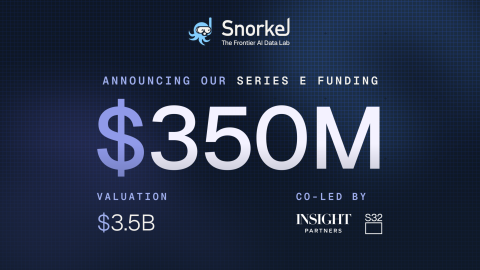
Snorkel AI, a San Francisco-based startup focused on AI data development, has raised $350 million in a Series E funding round at a $3.5 billion valuation. The round was co-led by Insight Partners and S32, with participation from existing investors including Addition, Lightspeed, Greylock, GV and Wells Fargo, along with several new investors.
The September 22 financing nearly triples Snorkel AI’s valuation from the $1.3 billion valuation it reached in its previous financing 17 months earlier.
The company’s rapid growth reflects a broader change in the AI industry. As frontier models become more capable and AI agents take on increasingly complex tasks, companies need more specialized datasets, evaluation systems and simulated environments to train and test those systems.
What Is Snorkel AI Building?
Snorkel AI began as a Stanford AI Lab research project focused on improving the way training data is developed. The company commercially launched in 2019 and initially became known for software that helped organizations automate data labeling.
Its business has since changed substantially.
In September 2025, Snorkel launched a data-as-a-service offering in which it provides customers with completed datasets rather than simply software for creating them.
The company now describes its approach as an “agentic data factory,” combining software, AI-generated data and human subject-matter expertise to create datasets, benchmarks, evaluations and environments for advanced AI systems.
That distinction is becoming increasingly important as AI development moves beyond relatively straightforward text classification and labeling tasks.
Modern AI systems may need data involving coding, law, healthcare, reasoning, computer use and other specialized areas. Building useful training and evaluation material for those applications can require domain expertise and carefully designed workflows.
Snorkel AI Says Revenue Has Surged
Snorkel AI says its data-as-a-service business has grown more than 18-fold over the past year.
The company reported an annualized revenue run rate of $375 million around the time of the financing announcement. Reuters separately reported that the company’s annualized revenue had risen from roughly $20 million the previous year to more than $350 million.
Those figures reflect Snorkel AI’s own reported business metrics rather than independently audited financial results.
The company says it works with AI labs, hyperscalers, enterprise customers, vertical AI companies and U.S. government agencies.
The new funding is intended to expand its data factory, increase investment in enterprise and vertical AI applications, and extend its research and technology into additional domains and modalities.
Why AI Training Data Is Becoming a Bigger Business
The early AI boom created enormous demand for labeled datasets. But the requirements for newer AI systems are becoming more complicated.
For an AI agent, simply knowing whether an answer is correct may not be enough.
Developers may need to evaluate whether an agent can complete a multi-step task, use tools correctly, navigate an environment, follow instructions, recover from mistakes and produce a reliable result.
That creates demand for richer forms of data.
Snorkel calls this transition “Data 2.0.” Its argument is that the data required by frontier AI systems increasingly resembles research and engineering work rather than basic labeling.
This is one reason the market is attracting startups that combine human expertise with AI-generated or simulated data.
TechCrunch reported that Snorkel’s model uses a hybrid approach in which software and models generate synthetic data alongside work performed by subject-matter experts.
For AI developers, the attraction is potentially significant: specialized data can help companies train and evaluate systems for particular industries and tasks without treating every data-development project as a large manual labeling operation.
The Shift From Data Labeling to Data Development
Snorkel’s evolution illustrates how the AI data market is changing.
Traditional data labeling often involved humans assigning categories or annotations to large collections of information. That remains useful, but increasingly sophisticated AI systems require more than labels.
They need examples of complex behavior.
They may also need evaluation benchmarks, simulated environments and expert-generated tasks that can expose weaknesses in an AI system.
This is particularly relevant to AI agents. An agent may appear capable in a simple demonstration but fail when it encounters a complicated workflow or unexpected condition.
Better evaluation data can help developers identify those failures before deploying systems to customers.
QueryFeedz readers can explore related concepts through its existing AI glossary, including AI models, AI inference, AI reasoning and training datasets.
Investors Are Betting on the Data Layer
Snorkel’s financing also illustrates where venture investors see opportunities in the AI value chain.
The biggest AI companies continue to spend heavily on computing infrastructure and model development. But those systems ultimately depend on data for training, evaluation and improvement.
Snorkel is positioning itself around that data layer.
The company’s new $350 million round gives it additional capital to expand its research and commercial operations while pursuing more enterprise and government customers.
Its previous financing valued the company at $1.3 billion. The new $3.5 billion valuation represents a substantial increase in less than two years, although private-company valuations are based on financing transactions and should not be treated as equivalent to public-market valuations.
What Happens Next?
The bigger question for Snorkel AI is whether demand for specialized AI data will continue growing as quickly as the company expects.
If AI systems become increasingly agentic and specialized, companies may need more sophisticated ways to train, evaluate and benchmark them. That could create a larger market for data companies that combine human expertise, software and synthetic environments.
But the economics of the business will matter as well. Producing high-quality expert data can be expensive, particularly in fields where qualified specialists are difficult to recruit.
Snorkel’s latest funding gives the company room to invest in that challenge.
For the broader AI industry, the financing is another indication that the infrastructure behind AI extends well beyond models and computing power. As systems become more capable, the quality and complexity of the data used to develop them may become an increasingly important competitive factor.